<span class="vcard">Marcella Di Lullo</span>
Marcella Di Lullo

2026 Accoglienza Pellegrina meeting

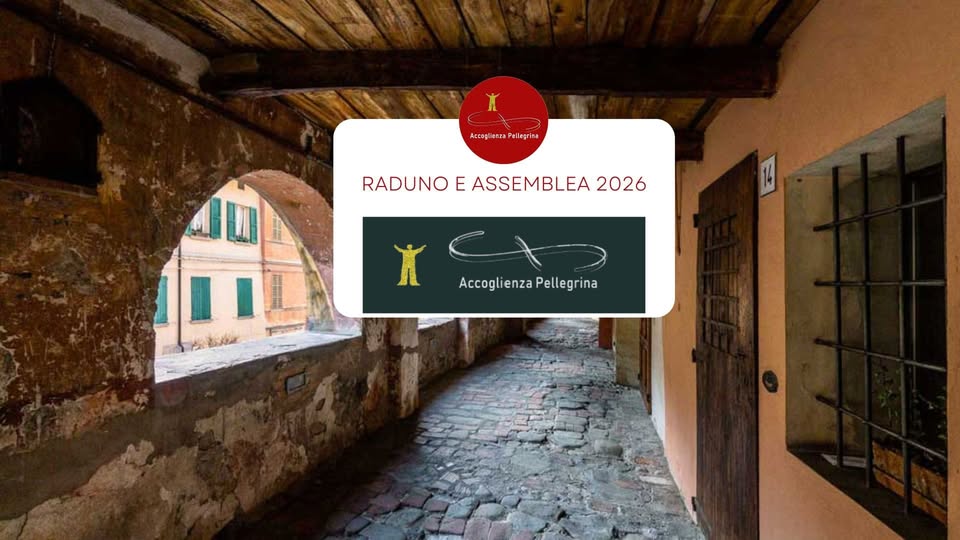
The 2026 Accoglienza Pellegrina meeting and assembly will be held from October 30th to November 1st. The event will be held in Fognano di Brisighella at the Emiliani Institute, Via Giuseppe Maria Emiliani, 54.
The participation fee is €90 per person for two nights full board (drinks included), with sleeping bags or your own sheets.
We will organize ourselves into groups to set, clear, and serve the table.
A room equipped with multimedia equipment will be available for the assembly.
Accommodation will be in double, triple, and quadruple rooms, all with en-suite bathrooms.

The tentative schedule includes arrival on Friday from 3:00 PM, with the assembly on Saturday from 9:00 AM to 1:00 PM.

In the afternoon, there will be an optional space for those who wish to explore topics and discussions in greater depth. Alternatively, a recreational activity will be planned that same afternoon. On Sunday morning, a tour of the town will be held. Lunch and a welcome to everyone will follow.

HOW TO GET THERE

🚆 BY TRAIN
📌The hamlet of Fognano is served by Trenitalia and can be reached from the Faenza railway station (trains approximately every hour, travel time 23 minutes, ticket price €2.70).
📌The Emiliani Institute is 400 meters from the Fognano station, a 5-minute walk along a path.

🚗BY CAR
📌A14 motorway, Faenza exit. The Emiliani Institute has a large internal parking lot.

Links for registration and the agenda of the assembly will follow.

Annual CEC assembly

The annual meeting of the European association CAMINO EUROPA COMPOSTELA was held on Friday, May 22, at the headquarters of the Galicia Europa Foundation, 38 Rue de la Loi, Brussels. Thirty associations representing twenty-two European countries participated. The meeting served to illustrate the activities carried out and the two flagship projects currently underway: Pilgrimage for Young People and Stars of the Jacobean Heritage. The 2025 budget was approved unanimously, and the new board of directors was appointed, with the following results:

Pascal Duchene VOTI 45
Philippe Dionnet VOTI 39
Patrice Bernard VOTI 39
Umberto Gallo VOTI 45
Fede Dewulf VOTI 42
Jorge Martinez-Cava VOTI 39
Piet Van Adrichem VOTI 45
Vedran Prazem VOTI 39

Our Pilgrim Hospitality Association has received particular praise for its work, which focuses on the values ​​of traditional hospitality, developed by our representative through intensive communication and presence in all relevant venues.

Being part of the European association is crucial because it provides a broad and comprehensive perspective on the entire Camino de Santiago scenario and allows us to connect with similar pilgrim associations and volunteers: a large network built on shared values.

A workshop for veteran hospitaleros in Valpromaro

Over the weekend of 10–12 April, in collaboration with the hosts, Marinella and Serenella, coordinated by Laura, the training coordinator, a group of 13 hospitaleros discussed and reflected on the centrality of the pilgrim and the transparency of the hospitalero – an essential pairing that forms the basis of our hospitality service.

The pilgrim takes centre stage whenever the hospitalero makes the pilgrim the focus of their attention and dedicates themselves to creating the conditions for the pilgrim to feel at home in the hostel, as if they were in their own home, and to feel listened to and understood. The other important point is: how do they do this? They do so without putting themselves at the centre, remaining invisible – ‘transparent’, in fact – placing themselves at the service of others whilst at the same time carrying out the essential work of ‘maintaining’ the hostel.

Starting from our personal stories, which allowed us to introduce ourselves and get to know one another, we identified some areas for further exploration: Expectations, Caring, Seeing Beyond, Responsibility, Stereotypes and Prejudices.

We split into small groups, each of which chose and then presented to the others a meaningful story capable of sparking a debate on the chosen theme. The stories presented featured pilgrims who, through their unpredictability, presented the hospitaleros with real decision-making dilemmas: misunderstandings, complex situations difficult to assess, and behaviour that is not always pleasant and can be exhausting to deal with.

This gave rise to a lively exchange of differing thoughts and perspectives, partly thanks to the use of the ‘devil’s advocate’ role, which often shed light on the less obvious aspects of situations and on the hospitalero’s own feelings or doubts. The range of considerations that emerged, whilst respecting differing opinions, was then distilled into a summary that we wish to share with hospitaleros who were unable to attend, as ‘tips’ that may serve as a guide to making our service as peaceful and enriching a human experience as possible.

  1. the way we look at things makes all the difference
  2. listening opens you up and enriches you
  3. participation: no hospitalero is an island
  4. trust in the universe
  5. before and after the encounter: we are no longer the same as before
  6. the other person is different from me and must be seen and treated as they are
  7. being aware of ourselves: thoughts, feelings, reactions
  8. Everyone is fighting a battle you know nothing about: be kind, always
  9. Every unexpected event, however painful, offers more possibilities
  10. We’re not all saints: let’s shake off the dust!
  11. intimacy creates a world: let’s enter it on tiptoe
  12. invest in light-heartedness
  13. ‘takeaway’ emotions
  14. tackling our sore points
  15. responsibility as a safeguard for pilgrims and the host
  16. inclusivity: respect for everyone’s space.

Fourth and final course for volunteer hospitaleros in Segni

The most recent course in Italy took place in the town of Segni, near Rome, at an altitude of 800 metres.

The snow covering the surrounding mountains did nothing to dampen the atmosphere of friendship that immediately developed between the participants and the trainers. During a break from work, our local host took us on a tour of the town and its massive walls. Once the course is over, the novatos, full of enthusiasm, will put their first experience of hospitality into practice.

Third training for Hospital Volunteers in Pontremoli

Our third training for new hospitaleros voluntarios took place in Tuscany over the weekend of March 13-15. The San Lorenzo Hospital, located in the former Capuchin Monastery of Pontremoli, hosted the sixteen participants and the team of veteran hospital volunteer trainers. Despite Saturday’s rain, the participants were able to explore the city, full of hidden corners.

Once again, both the newcomers and the trainers returned satisfied, with a sense of accomplishment and the atmosphere of unity and solidarity that characterizes each course.

The new hospitaleros voluntarios now eagerly await their next assignment, where they will reciprocate the warm welcome they have received, as the international family of hospital volunteers continues to grow.

The second training for hospitaleros voluntarios workers in Turin

The second course for volunteer hospitaleros took place in Turin on the last weekend of February 2026.
The historic complex that hosted us is the Church of the Visitation of the Virgin Mary with its Cistercian monastery founded in 1617, near the ancient Mirafiori Castle. The monastery currently offers lodging to groups of young people and pilgrims walking from Montgenèvre to Rome and back to Santiago de Compostela.

The 15 new participants, accompanied by a group of experienced volunteers, spent a weekend experiencing traditional hospitality and exploring the many facets of life as a hospitalero. They also visited the air raid shelters in the church’s basement, which protected the neighborhood’s residents during World War II.

The meeting provided a further opportunity to discuss the Camino de Santiago and the pilgrimage route, renewing their commitment to hospitality.

Like the new aspiring hospitaleri, the training team—Laura, Marinella, Angelo, Barbara, José Luis, Marcella and Umberto—and the interns, Emilio, Ornella, and Giovanni, will be engaged in service both in Italy along the Via Francigena and in Spain along the Camino de Santiago.
Thank you all for your hard work and dedication, without which it would be difficult to maintain the spirit of hospitality in the hostels.

First training for new hospitaleros voluntarios in Italy

The ancient Abbey of Praglia, nestled in the hills of the province of Padua, welcomed a new group of 15 novatos who participated in the first training course for hospitalero voluntarios in Italy. Sheltered from the rain, veterans and newcomers were able to exchange views on the meaning of the Camino and hospitality. They also explored the factors that allow pilgrims to feel at home and experience the spirit of the Camino while staying in a hostel.

The meeting with the aspiring hospitaleros voluntarios represents an important opportunity for the formators to renew their spirit of service and continue to consider themselves a bridge between pilgrims and traditional hospitality networks.

The participants were able to tour the Abbey accompanied by Padre Giacomo, a Benedictine monk, exploring the ancient library and spacious dining halls.

A blue sky allowed for the joyful delivery of the muñequito under a spring sunshine, a promise of many happy encounters.

Updated Accomodation section

We’ve updated our website’s section dedicated to hostels and accommodations along the Via Francigena to Rome. The pages, completely redesigned, now include a map of the facilities and offer clearer, more up-to-date, and easily accessible information for all pilgrims planning their journey. Our list, the most comprehensive and up-to-date online, is frequently downloaded by pilgrims, so we’ve assessed the need to update and make the key data accessible, using easy-to-understand graphics that summarize the accommodation options and services available.

The new version allows for intuitive navigation with a more comprehensive overview of the opportunities available along the various routes.

You can:
📌 view the accommodations managed in collaboration with Accoglienza Pellegrina
📌 download the PDF of the general list of all accommodations
📌 view the interactive map to locate the facilities.

We invite you to contribute with any feedback to maintain a consistently accurate and participatory mapping of accommodations.

Write to us at 📧accoglienze.vf2025@gmail.com indicating the name of the place, the city and, if you like, also a brief description.

2026 training calendar

The 2026 training calendar is now available.
The training activities are aimed at volunteers and anyone interested in learning more about or learning more about the pilgrim reception service along the routes. The program includes meetings dedicated to the main aspects of volunteering, organizing reception, and sharing experiences.

Participation requirements are:

  • Have been on a pilgrimage to Santiago or to Rome or to another devotional route of sufficient length (at least 400 km) to become aware of the needs of pilgrims and experience traditional hospitality;
  • Have attended a short training course to learn about the work in the pilgrim hostels and the principles that guide hospitaleros voluntarios ;
  • To be available for service in the same year as the course, to complete the classroom training. In Spain, the shifts last 15 days, in the first or second fortnight of each month. In Italy, the service is usually weekly, from Saturday to Saturday.

Below are the dates and locations, which can also be found in the dedicated section of the association’s website.

  • PRAGLIA (Padova) ➡️13,14,15 FEBRUARY
  • STUPINIGI (Torino) ➡️ 27, 28 FEBRUARY, 1 MARCH
  • PONTREMOLI (Massa) ➡️ 13,14,15 MARCH
  • SEGNI (Roma) ➡️ 27, 28, 29 MARCH

Algorithms and the Camino de Santiago: USC analyzes the digital transformation of pilgrimages

An interesting study on the emergence of digital technology in the Camino experience. The study’s goal is to encourage walkers to reflect on their use of technology during the pilgrimage, suggesting a balance between connection and disconnection. In recent years, the rise of planning apps and the spread of online experiences have revealed a new digital culture surrounding the Camino. The study concluded with the publication of the guide “Digital Authenticity on the Camino.”

This is the link to the original article.

Here you can download the guide “Digital Authenticity on the Camino” 👉Guia-peregrinos

Hospital volunteers and hospital volunteers over 75 years of age

The FEAACS (Spanish Federation of Associations of Friends of the Camino de Santiago), through a news item on its website, sought to clarify the reasons behind Hosvol’s decision to employ elderly hospitaleros. It concludes by appealing to the reasonableness that most volunteers will surely apply, putting an end to this fruitless and sad controversy. This is the link to the original news item.

Hospital volunteers and hospital volunteers over 75 years of age

The FEAACS (Spanish Federation of Associations of Friends of the Camino de Santiago), through a news item on its website, sought to clarify the reasons behind Hosvol’s decision to employ elderly hospitaleros. It concludes by appealing to the reasonableness that most volunteers will surely apply, putting an end to this fruitless and sad controversy. This is the link to the original news item.

C.E.C. Autumn Meeting

(Fonte immagine Administration C.E.C.)

Camino Europa Compostela, an association of which we are a member along with many other European associations, continues its work. On 26 November, a meeting was held during which the association’s founding principles were revisited. It was also an opportunity to welcome representatives from Ukraine and Slovenia. We are all working on projects that have as their common theme the consolidation of the European values of equality, fraternity and interculturalism. Much attention is paid to the tradition of hospitality and the promotion of sustainable tourism.

C.E.C. conducted a survey on the motivations and values that animate the various associations. The survey was based on three points:

  • What projects are being worked on to consolidate European values among members;
  • What is expected from C.E.C. and what has been achieved so far;
  • How can we contribute to the consolidation of European values.

The research highlighted a strong commitment to strengthening European identity through collaboration, sharing values and promoting joint projects.

It is very important for everyone to keep alive the tradition of hospitality and the promotion of the Jacobean routes. It has emerged that C.E.C.’s activities have brought about a strong sense of belonging, allowed for the sharing of good practices in the sector and increased mobility on the routes.

On our website, on the dedicated PAGE, you will find an overview of what C.E.C. does and what role AP plays within it.


AP Meeting and General Assembly: how did it go?

The Accoglienza Pellegrina meeting for the year 2025, held from 31 October to 2nd of November in Rome at the Franciscan Fraternity of Bethany was an important opportunity for members to meet and share experiences. The event was attended by about 70 people from all over Italy, who were able to enjoy an experience based on the values and principles of Accoglienza Pellegrina: welcome, hospitality, generosity, and appreciation of the pilgrimage routes.
Various activities took place over the three days: a beautiful walk to Rome with a short guided tour around the Vatican area; evening entertainment aimed at increasing the sense of belonging and team spirit; and free time.
The highlight of the event was the annual meeting, during which the results of the past year were reviewed, with ample opportunity for constructive discussion among members. Members will receive the minutes of the meeting by email. The meeting ended on a positive note, leaving participants with a strong sense of community, as evidenced by the feedback received through a survey, the results of which we are publishing.
Special thanks go to the board and all the organisers for their fundamental contribution to the success of the event. Photos and highlights are already available on our social media channels.

Survey results (46 responses received)


General Assembly of Religious Paths and the Via Francigena

On 17 October, a conference on the States General of Religious Routes and the Via Francigena was held in Piacenza. Representatives from the Emilia Romagna institutions, the European Association of Via Francigena Ways and the main representatives of the Via Francigena and related routes were in attendance. The meeting aimed to network the routes in the Emilia Romagna region (the Via Francigena, the Via degli Abati towards Rome and the Cammino di San Colombano with reference to the Abbey of Bobbio) and to promote an authentic, physical, spiritual and cultural pilgrimage experience while supporting the region in terms of hospitality, services and infrastructure.

Our president spoke about the concept of donation-based hospitality: what donation-based hospitality is, where it originated, what it offers, whether it still makes sense today, and who the volunteer hospitaleros are. Our values and the role that Accoglienza Pellegrina wants to play on the routes were emphasised. Finally, a brief presentation was given on the facilities with which we collaborate.

AP Meeting and General Assembly 2025 Programme

The 2025 Accoglienza Pellegrina meeting and general assembly will be held from October 31st to November 2nd. The meeting will take place in Rome at the Franciscan Fraternity of Bethany at Via D. M. Brun Barbantini, 151 which can be reached by train from Termini (Giustinian stop). Below is some useful information.

  • We look forward to seeing you from 3 p.m.
  • Please bring your own towel, sleeping bag or sheets; blankets are provided by the accommodation.
  • We kindly request that you be punctual for breakfast, lunch, and dinner.
  • Click HERE to download the programme for the event

ADRIA CAMINO FESTIVAL: how did it go?

As we said in the August newsletter, the ADRIA CAMINO FESTIVAL took place in Sibenik, Croatia, from September 26th to 28th, and our association participated. It was an interesting opportunity to discuss the routes to Santiago originating in Eastern European countries and to analyze phenomena related to the development and evolution of pilgrimages. AP participated in the events on hospitality, a fundamental element for the existence of devotional routes, and also promoted the two most significant routes in the area: the Via Francigena and the Via Postumia. In Sibenik there is one of the most beautiful cathedrals dedicated to St. James. A long walk on part of the Croatian route was also included, with a large group of pilgrims. In an atmosphere of brotherhood and sharing, we initiated collaborative projects with representatives of associations in Slovenia, Poland, and Ukraine, and consolidated those with our traditional partners.

ADRIA CAMINO FESTIVAL second edition

The 2nd ADRIA CAMINO FESTIVAL will be held in the city of Šibenik, Croatia, from September 26 to 28, 2025. It aims to be a celebration of the Camino routes, pilgrims, and the stories shared across Europe. Everyone is invited to join us to discover the existing routes in over 20 European countries.

What to expect?

With “QR Camino Europe” we’ll be able to explore the different Camino routes in Europe: by scanning QR codes in the old town, we’ll be able to watch interactive stories and receive a unique Compostela.

With “Voices of the Camino” we’ll find a panel open to pilgrims, roundtable discussions, and inspiring stories of pilgrims who have walked long distances, helped others, or experienced truly memorable journeys.

With “Camino Encounters” you can walk the local route, explore the open-air fair, meet pilgrims from all over Europe, and enjoy films, exhibitions, and much more.

The 2nd ADRIA CAMINO FESTIVAL is organized by the “Camino Europa Compostela” Federation, the Šibenik Tourist Board, and the Croatian Brotherhood of St. James. The latter is a non-profit organization whose goal is to promote the cultural, historical, and spiritual heritage of the Camino de Santiago. It is the official Croatian representative at the “Camino Europa Compostela” Federation and the Universal Archfraternity of the Apostle Santiago in Santiago de Compostela.

Camino Croatia is a project that aims to promote cultural heritage and a common European identity, support the sustainable development of local communities, promote healthy lifestyle habits, and offer a unique and effective way to relieve stress. It brings together people from different segments of society and helps people find their inner peace. The first edition of the Adria Camino Festival in 2024 brought together over 500 Camino enthusiasts from across Europe for an unforgettable weekend in Pula, filled with shared stories, inspiring talks, and the energy of a true pilgrimage.

AP Meeting and General Assembly 2025

The 2025 Accoglienza Pellegrina meeting and general assembly will be held from October 31st to November 2nd. It will be an opportunity for a day of sharing, inspiration, and vision for the future. The meeting will take place in Rome at the Franciscan Fraternity of Bethany at Via D. M. Brun Barbantini, 151 which can be reached by train from Termini (Giustinian stop).

We will have 77 places available, divided into triple, quadruple, and quintuple rooms. Priority will be given to novatos who have completed their service, followed by veterans who have also completed their service. Ordinary members will remain on standby until ten days before the event. Once all places are filled or those who join later will be guaranteed participation in the meeting and scheduled activities but they will be responsible for their own food and lodging.

Registration must be completed by the form at the link and attaching a copy of proof of payment of the €75/person contribution (IBAN IT87N0306967684510787288103).

We look forward to seeing you on Friday, October 31st, starting at 3:30 PM. Dinner is scheduled for 7:30 PM, along with members of the community who will be preparing the meals.

We have planned a day of walking to reach St. Peter’s, walking part of the last path of the Via Francigena. Registered participants will be sent the final three-day program.

Wishes from CEC President Pascal Duchêne

“Dear friends,
On behalf of Camino Europa Compostela, I am very honoured and delighted to wish you a very happy Saint James’ Day.
On this day, it is important to remind our members and supporters of the significance of the pilgrimage to Santiago de Compostela and, by extension, the essential role that the Camino de Santiago and pilgrims have played and continue to play in shaping the identity of our European society and spreading its values throughout the world.
These routes are places of fraternal sharing, hospitality and welcoming others in their differences and with respect. They are places that have become essential today for promoting, maintaining or rebuilding peace. They are places of freedom that must inspire us so that the future remains full of hope for our future generations.
Walking the paths of Saint James means being a stranger, a migrant crossing unknown territory, discovering it thanks to the hospitality of those who welcome them and, in return, learning to understand customs, ways of life and traditions that were unknown to them before they set out.
This ‘stranger’, who we are on the road to Santiago, also learns to become the future “hospitalero” that we will be, transformed by the road, on our return from our journey, our pilgrimage. The path shapes and initiates us. It takes us, even though at the beginning we thought we were choosing and organising it according to our needs and our ignorance of its true essence.
For some, the divine graces lavished upon us through the intercession of the apostle who joins our steps and our prayers lead us to Christ. We can also recognise this encounter in our travelling companions.
For others, the path opens the way to beautiful spiritual encounters in the broadest sense, exchanges of reflections on the beautiful values that comfort our humanity, because walking to Compostela is also an extraordinary humanistic journey.
So, on this day of celebration, let us think of all these important aspects of the Ways of Saint James and its pilgrimage, which unite us all on our own paths of life. On this day, let us spare a thought for each other and for all the pilgrims of the world, for all those who are also walking in search of a better life.
Long live Saint James and his paths! Ultreia!
Pascal Duchêne
President, Camino Europa Compostela”

Hermann Künig Award to HOSVOL

Hospitaleros Voluntarios, founded 35 years ago under the auspices of the Spanish Federation of Friends of the Camino de Santiago Associations, has received the Hermann Künig Hospitality Award, created to recognize both individuals and institutions that stand out for their altruistic assistance to pilgrims. This is the first year the Hospitality Award has been awarded. It is named Hermann Künig, in memory of the German monk who wrote the first pilgrim’s guide in the 15th century.

Since 1990, the Volunteer Hospitallers have worked along the various pilgrimage routes on a voluntary basis and in solidarity with pilgrims. It is a very large group, with over 10,000 people from every continent participating since its inception—more than 700 in 2024—selflessly and freely, practicing traditional Jacobean hospitality in dozens of donation-based hostels. Members receive training before beginning their work; they are pilgrims, moved by the altruism they have witnessed along their journey, who therefore decide to dedicate part of their free time to assisting pilgrims on the European routes, practicing traditional hospitality.

This year they serve in the hostels of Santa Cilia, Arrés, Zabaldika, Pamplona, Estella, Viana, Logroño, Grañón, Bercianos del Real Camino, El Burgo Ranero, Calzadilla de los Hermanillos, Calzada de Coto, La Virgen del Camino, Villadangos del Páramo, Ponferrada, Cacabelos, Castilblanco de los Arroyos, Alcuéscar, Puerto Béjar, Salamanca, Zamora, Puente Duero, Medina de Rioseco, Alfaro and Alcanadre.

The group is led by the HOSVOL Coordinator, who is a member of the Board of Directors of the Federation of Camino de Santiago Associations. Since its inception, four coordinators have served in this role: José Ignacio Díaz, Francisco Sánchez, Ana I. Barreda, and Manuel Oliva. The Hermann Künig Hospitality Award, consisting of a terracotta plaque, celebrates hospitality as a historical and identifying value of the Camino de Santiago, a particularly important objective in these times when commodification prevails, where everything has a price rather than a value.