PRESS REVIEW
PRESS REVIEW

Algorithms and the Camino de Santiago: USC analyzes the digital transformation of pilgrimages

An interesting study on the emergence of digital technology in the Camino experience. The study’s goal is to encourage walkers to reflect on their use of technology during the pilgrimage, suggesting a balance between connection and disconnection. In recent years, the rise of planning apps and the spread of online experiences have revealed a new digital culture surrounding the Camino. The study concluded with the publication of the guide “Digital Authenticity on the Camino.”

This is the link to the original article.

Here you can download the guide “Digital Authenticity on the Camino” 👉Guia-peregrinos

Hospital volunteers and hospital volunteers over 75 years of age

The FEAACS (Spanish Federation of Associations of Friends of the Camino de Santiago), through a news item on its website, sought to clarify the reasons behind Hosvol’s decision to employ elderly hospitaleros. It concludes by appealing to the reasonableness that most volunteers will surely apply, putting an end to this fruitless and sad controversy. This is the link to the original news item.

Hospital volunteers and hospital volunteers over 75 years of age

The FEAACS (Spanish Federation of Associations of Friends of the Camino de Santiago), through a news item on its website, sought to clarify the reasons behind Hosvol’s decision to employ elderly hospitaleros. It concludes by appealing to the reasonableness that most volunteers will surely apply, putting an end to this fruitless and sad controversy. This is the link to the original news item.

Hermann Künig Award to HOSVOL

Hospitaleros Voluntarios, founded 35 years ago under the auspices of the Spanish Federation of Friends of the Camino de Santiago Associations, has received the Hermann Künig Hospitality Award, created to recognize both individuals and institutions that stand out for their altruistic assistance to pilgrims. This is the first year the Hospitality Award has been awarded. It is named Hermann Künig, in memory of the German monk who wrote the first pilgrim’s guide in the 15th century.

Since 1990, the Volunteer Hospitallers have worked along the various pilgrimage routes on a voluntary basis and in solidarity with pilgrims. It is a very large group, with over 10,000 people from every continent participating since its inception—more than 700 in 2024—selflessly and freely, practicing traditional Jacobean hospitality in dozens of donation-based hostels. Members receive training before beginning their work; they are pilgrims, moved by the altruism they have witnessed along their journey, who therefore decide to dedicate part of their free time to assisting pilgrims on the European routes, practicing traditional hospitality.

This year they serve in the hostels of Santa Cilia, Arrés, Zabaldika, Pamplona, Estella, Viana, Logroño, Grañón, Bercianos del Real Camino, El Burgo Ranero, Calzadilla de los Hermanillos, Calzada de Coto, La Virgen del Camino, Villadangos del Páramo, Ponferrada, Cacabelos, Castilblanco de los Arroyos, Alcuéscar, Puerto Béjar, Salamanca, Zamora, Puente Duero, Medina de Rioseco, Alfaro and Alcanadre.

The group is led by the HOSVOL Coordinator, who is a member of the Board of Directors of the Federation of Camino de Santiago Associations. Since its inception, four coordinators have served in this role: José Ignacio Díaz, Francisco Sánchez, Ana I. Barreda, and Manuel Oliva. The Hermann Künig Hospitality Award, consisting of a terracotta plaque, celebrates hospitality as a historical and identifying value of the Camino de Santiago, a particularly important objective in these times when commodification prevails, where everything has a price rather than a value.


RECEIVING THE TESTIMONIUM IN ROME

Pilgrims who have walked the Francigena or other devotional routes can obtained the Testimonium at the Pilgrims’ desk  located in the long corridor that leads to the tombs of the Popes; facing St. Peter’s, it is on the right side. (see pictures).

Here the credential is stamped and the testimonium is issued. To obtain the Jubilee Testimonium, please go to the Jubilee Info Point at Via della Conciliazione 7.

                    TRADITIONAL TESTIMONIUM                JUBILEE TESTIMONIUM


Three new trees in the Wood of Souls in Mostelares

A group of Hospitaleros Voluntarios del Camino de Santiago paid tribute to three deceased companions on Sunday 28th January: “Resti” Gutiérrez, “Justi” Infante and José Ignacio Díaz. Around 30 people from different parts of Spain went to Mostelares, on the outskirts of Castrojeriz, to plant three trees and place plaques at their feet.
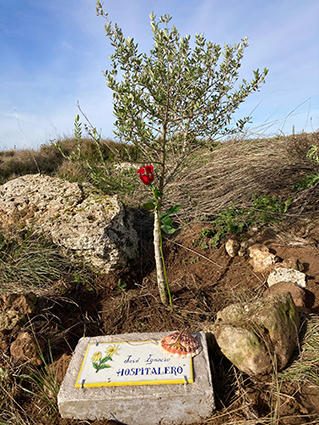
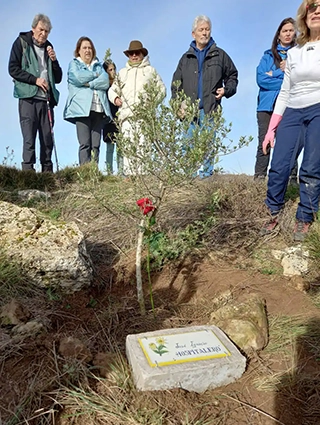
This is a custom that dates back to 2015, in memory of the disappeared comrades: an olive, almond or holm oak tree is planted in their memory in an area called El Bosque de las Almas (The Wood  of the Souls).

The event was of particular importance to the group, which paid tribute to José Ignacio Díaz, the founder of Hospitaleros Voluntarios, parish priest of Santiago el Real de Logroño, pilgrim and hospitalero, and “prominent figure”. The idea of traditional, voluntary and fraternal hospitality, which characterises this group of volunteers, came from him and was presented at the First International Forum of the Pilgrim’s Way to Santiago, held in Jaca (Huesca) in 1987, in order to serve the pilgrims, whose numbers began to grow in the 1980s. Hospitaleros Voluntarios was ‘officially’ born in 1990 with the first hostel in Hornillos del Camino, where its  volunteers served.

Resti Gutiérrez was in charge of the municipal hostel in Castrojeriz for many years, while Justi Infante, a “humble and loving worker”, came to the Pilgrim’s Way thanks to his doctor’s prescription.

After the trees were planted, ceramic plaques from the workshop of a ceramist in Triana, Seville, were placed to commemorate the work of the three volunteers.